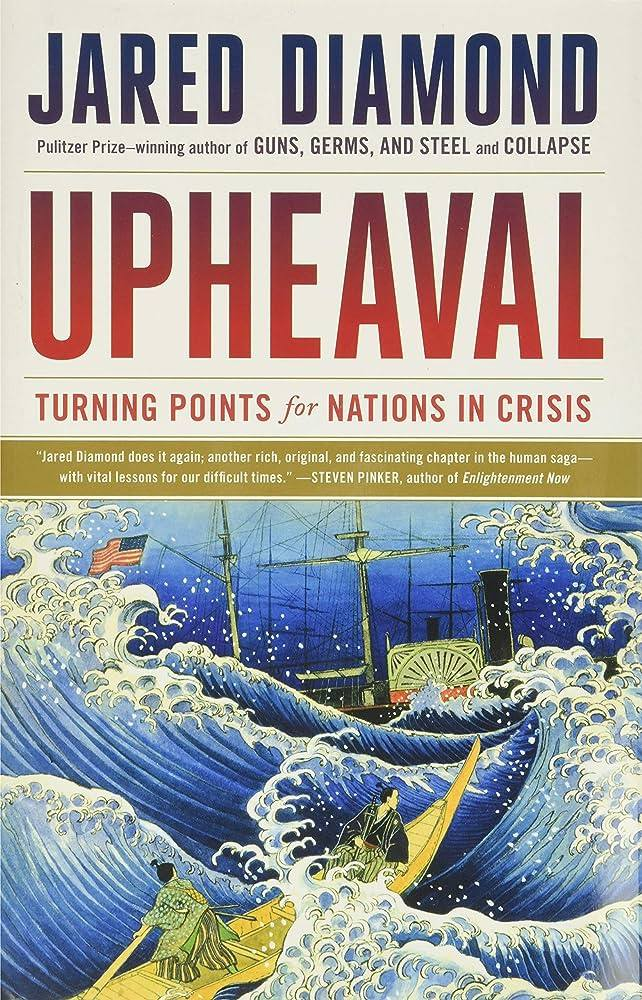
Reading this book left me with a profound sense of gratitude. I feel fortunate to be a Vietnamese citizen born in an era of peace, free from the devastation of falling bombs and without being dependent on another power. Interestingly, while Jared Diamond’s work doesn’t focus much on Vietnam, reading it made me reflect deeply on our own journey. Every country has its limitations, but looking at the long arc of history, I believe the decisions made by our leaders were timed correctly, the best possible choices for our survival. “Independence – Freedom – Happiness” remains our ultimate priority, and we have preserved a distinct national identity thanks to the sacrifices of previous generations.
About the Author and the Journey
Jared Diamond is a polymath, a professor of physiology with vast expertise in history, linguistics, archaeology, and politics. He doesn’t just write from a library; he travels to these continents to experience the events firsthand. This gives his writing a “popular science” feel, concise and accessible, though the sheer volume of information is a challenge. It took me 3 to 4 months to finish, and honestly, it will take much longer to fully digest and fact-check everything.
The Framework: Selective Change
Diamond explores how six nations faced, managed, and overcame crises. He draws a fascinating parallel between individual crisis management and national survival. The key, he argues, is “selective change.” He proposes 12 factors to evaluate how a nation handles a crisis:
- Building a national consensus that a crisis exists.
- Accepting responsibility to do something.
- Building a fence (defining the problems to be solved).
- Getting material and financial help from other nations.
- Using other nations as models for how to solve problems.
- National identity.
- Honest self-evaluation.
- Historical experience of previous crises.
- Dealing with national failure.
- Situation-specific national flexibility.
- National core values.
- Freedom from geopolitical constraints.
National Case Studies: Successes and Shadows
Finland & Japan: The Wake-up Calls I found these two chapters the most compelling. Before 1853, Japan knew about the Opium Wars but didn’t act until Commodore Perry’s black ships entered Tokyo Bay. Similarly, Finland was aware of Soviet expansionism but didn’t expect a full-scale threat until the Winter War (1939-1940). Both nations stopped acting like “victims” and took full responsibility for their defense and modernization, using other successful nations as models to build the powerhouses they are today.
Chile & Indonesia: Rising from Violence These chapters cover the Pinochet dictatorship in Chile and the mass purges under Suharto in Indonesia. Indonesia successfully defended its independence from the Netherlands (1945–1949) and focused on its core identity to rise from adversity. However, I found these chapters a bit confusing, the link to the 12-factor framework felt looser here, and I struggled to see why these specific paths were presented as the “best” available scenarios.
Germany & Australia: The Search for Identity Germany spent 45 years post-WWII finding stability, eventually becoming the “big brother” supporting much of Europe’s economy. Australia’s crisis was more of a post-colonial identity search. There is still much debate on how much they have rejected or accepted their British roots, but both nations showed incredible patience in rebuilding their core values.
A Word of Caution: Fact-Checking is Key
While Diamond’s insights are sharp, some details require a grain of salt. He often relies on personal anecdotes or friends’ accounts rather than just academic citations.
- Example 1: He claims Australian Rules Football is played only in Australia, yet leagues exist in China, Canada, and France.
- Example 2: He states a 1976 assassination in D.C. was the “only known case of a foreign terrorist killing a U.S. citizen on U.S. soil,” overlooking the 1993 World Trade Center bombing.
Final Thoughts
Upheaval is an incredible experience for anyone wanting a macro-view of history and politics. It teaches us that nations, like people, must be flexible enough to change what isn’t working while holding onto the core values that make them who they are.