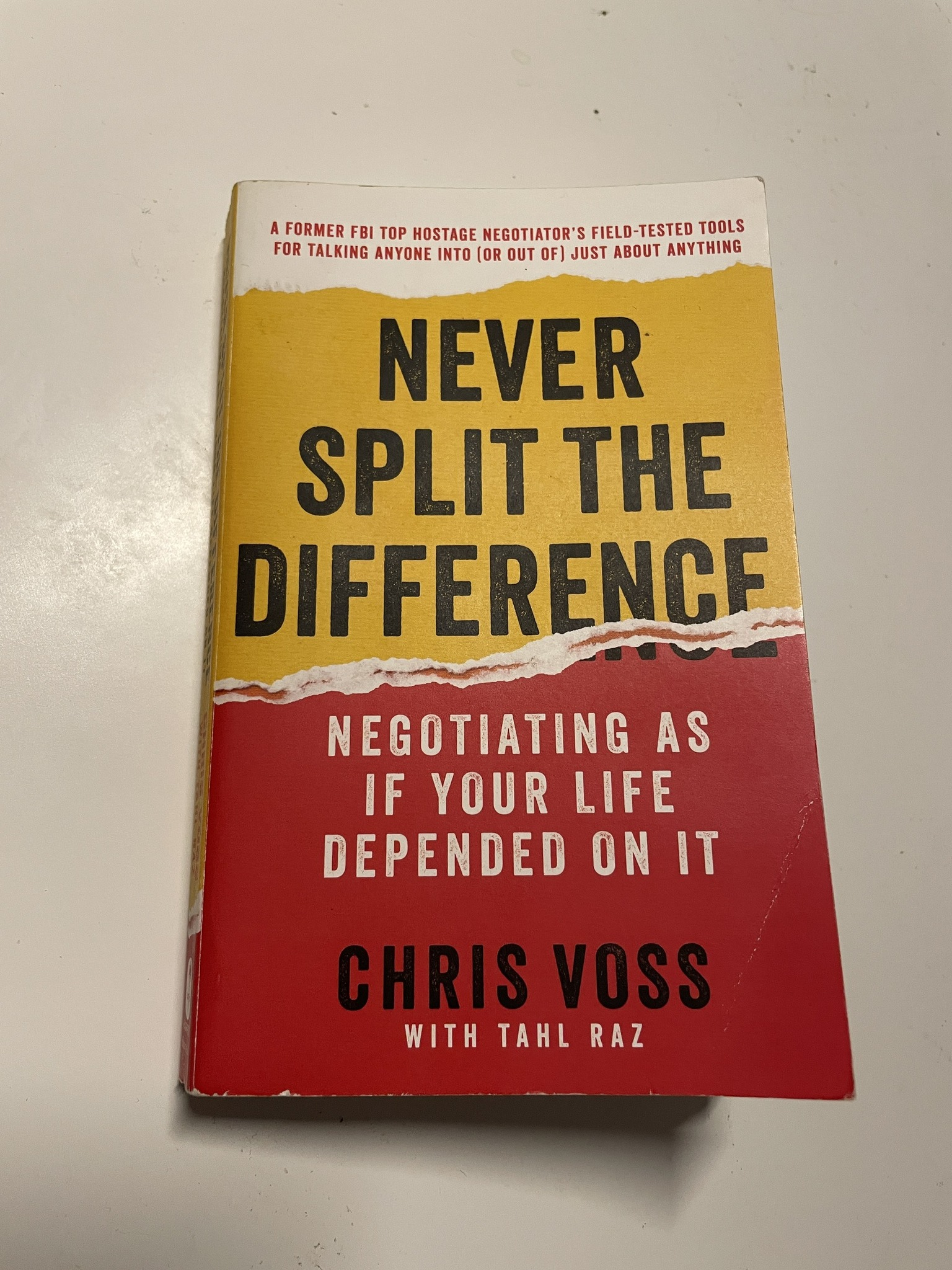
I’m on the fence about whether to recommend this one. While it’s a global bestseller and has some undeniable truths, I struggled with the application. Chris Voss is a former lead FBI hostage negotiator who also studied at Harvard. This “bullets-to-boardrooms” background makes his advice feel a bit extreme.
If you’re in high-pressure sales or constant commercial combat, his rapid-fire psychological tactics will make sense. For the rest of us, it requires some serious filtering. As I get older, I find my “critical thinking” filter gets finer—I’m less interested in being brainwashed and more interested in what actually works in the real world.
What Hits the Mark ✅
1. The Power of Active Listening Before you can be heard, you must listen. Voss introduces Mirroring: repeating the last few words of what someone said. It’s simple, but it signals deep interest. Only someone truly listening cares enough to dig deeper. Don’t rush to the closing; impatience signals that you don’t value the other party, which kills the deal instantly.
2. The “Late-Night FM DJ” Voice Tone is a weapon. Using a calm, downward-inflecting voice (think high-quality podcasts or ASMR) puts people at ease. When people feel safe, they open up. Information is the ultimate leverage—you need them to talk so you can strategize your next move.
3. Slow is Smooth, Smooth is Fast Going slow gives you time to gather intel. Notice how world leaders often use interpreters even when they speak the language fluently? It’s a strategic buffer. It ensures 100% comprehension and buys precious seconds to formulate a response.
4. The Myth of Win-Win I agree with Voss here: “Win-Win” is often a trap or a lazy compromise. In reality, the world isn’t always fair. I’m not a fan of meeting in the middle just for the sake of it. Sometimes, a deal is “all or nothing.” If the other side wants the whole cake, giving them half of yours isn’t a “win”—it’s a loss.
5. Partners, Not Adversaries Treating everyone at the table as a partner rather than an enemy aligns with my own strategy. Respect leaves a lasting impression, especially when you’re negotiating with competitors in front of clients.
What Misses the Mark ❌
1. The Labeling Trap Voss suggests “labeling” emotions (e.g., “It seems like you’re frustrated”). He claims this shows empathy. I disagree. Labeling someone’s feelings can feel presumptuous or even condescending. I prefer letting the other person define their own state. I’ll only step in to help name a feeling if they are clearly struggling to find the words.
2. The “No” Philosophy Voss argues that “No” is the start of a negotiation because it makes the speaker feel safe and in control. I researched this. In his books and William Ury’s Getting to Yes, they rely heavily on personal anecdotes. However, cross-cultural studies (like Joan Rubin’s 1981 work) show that “No” varies wildly by geography. In some cultures, a “No” means “Stop talking,” while in others, it’s just a polite opening. Voss’s take feels a bit too Western-centric and one-dimensional here.
3. Fishing for “That’s Right” Voss wants you to get the opponent to say “That’s right.” But if you’re dealing with a veteran sales pro, they might say “That’s right” just to move you along or play into your hand. A verbal confirmation isn’t always a green light to proceed.
4. Inconsistent Execution The title suggests life-or-death stakes, yet some of his closing techniques aren’t as aggressive as real-world business “street fighting.” If business is a battlefield, the book feels a little soft in the final act.
5. Problematic Examples A lot of the hostage examples focus on specific religious groups. As many reviewers on Goodreads have noted, these examples feel dated and biased. It would have been much more persuasive if he had used broader, more objective business contexts.
Final Verdict
Read it for the psychological tools (Mirroring, Labeling, Calibrated Questions), but take the “life or death” drama with a grain of salt. It’s a tactical manual, not a universal law.